
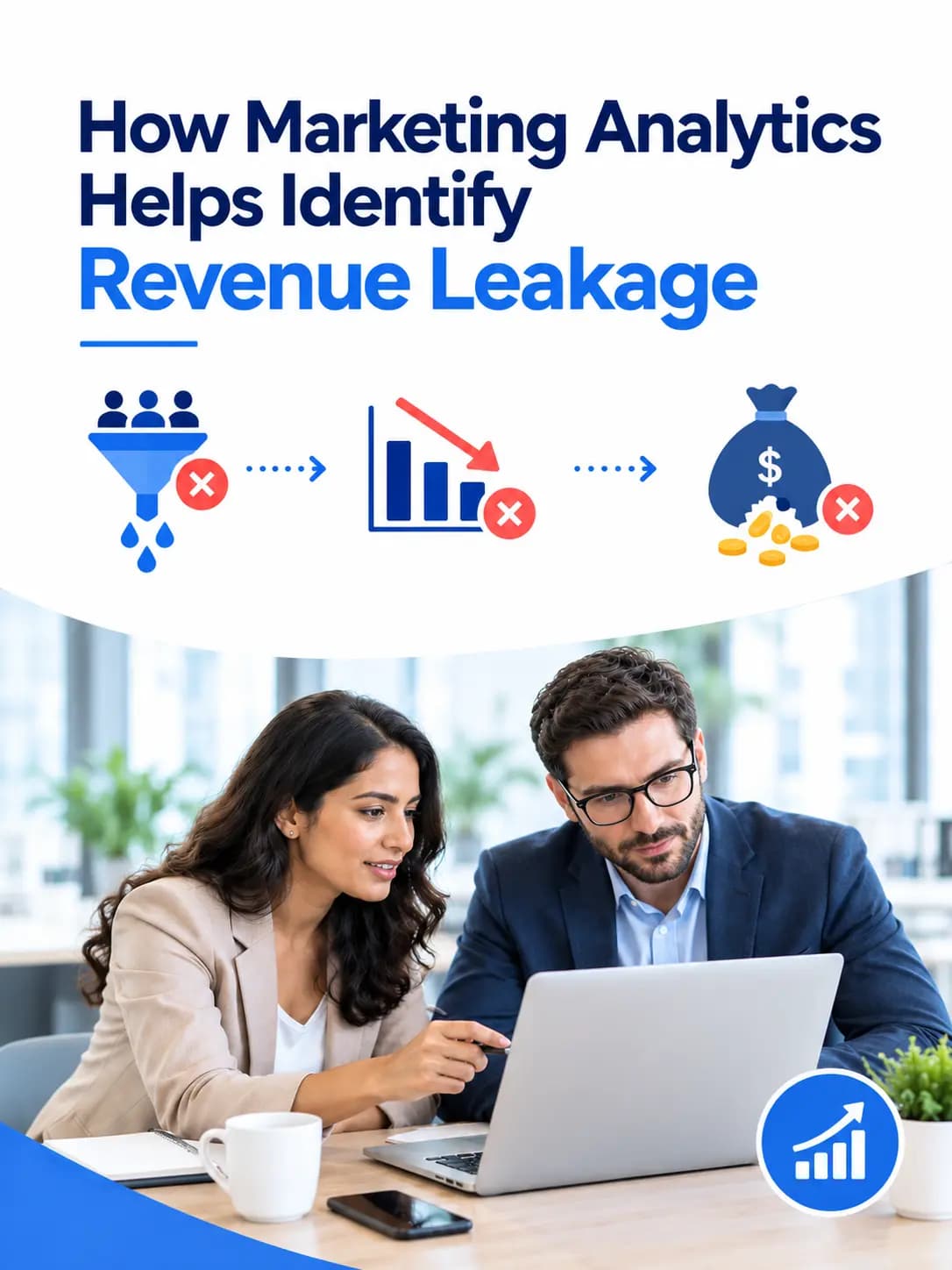
How Marketing Analytics Helps Identify Revenue Leakage
Most businesses do not lose revenue in obvious ways. There is rarely a single failure point or a sudden drop in performance. Instead, revenue slowly disappears through small gaps in marketing execution, customer journeys, pricing decisions, and conversion flows. These gaps often go unnoticed because they are spread across multiple systems and teams.
For example, a campaign may generate thousands of leads, but only a small percentage may become profitable customers. A discount may increase conversions while quietly reducing margins. A marketing channel may show strong ROAS even though some of those customers would have purchased without the campaign. These issues may not look serious on their own, but together they can create a significant revenue gap.
Revenue leakage refers to this hidden loss of income that should have been earned but is not realized due to inefficiencies in tracking, targeting, engagement, or retention. It is not always about lack of effort. Marketing analytics plays a critical role here because it connects fragmented data and turns it into a clear view of performance across the entire funnel.
Where Revenue Leakage Happens in Marketing
Revenue leakage usually builds gradually across different parts of the customer journey. Each stage may look normal on its own, but together they create a significant revenue gap.
- Funnel drop-offs: Customers show interest but drop out at key stages before conversion. If 1,000 high-intent visitors enter a funnel but only 50 become customers, the missed conversions represent potential revenue that the business could have captured.
- Weak lead quality: Marketing brings in traffic that does not match buyer intent, resulting in low conversion rates.
- Pricing and discount leakage: Discounts and offers reduce revenue without improving long-term customer value.
- Customer churn: Customers leave early or fail to engage after purchase, reducing lifetime value.
- Poor attribution visibility: Businesses cannot clearly identify which channels are actually driving revenue.
These issues often exist at the same time, making it difficult to understand the real source of revenue loss without structured analysis.
How Marketing Analytics Identifies Hidden Revenue Loss
Marketing analytics helps businesses move from assumption-based decisions to data-backed clarity. By tracking the full customer journey, it becomes easier to identify exactly where users drop off and why revenue is not being captured effectively.
It works by connecting multiple data points such as campaign performance, customer behavior, and sales outcomes. This makes it possible to see not just what is happening, but where the system is breaking.
Key areas where analytics helps include:
- Funnel analysis: Maps conversion across the full journey rather than measuring isolated campaign stages.
- Conversion tracking: Measures how effectively traffic turns into leads, trials, or purchases.
- Campaign performance analysis: Shows which campaigns generate the most profitable customers by connecting campaign data with sales, margins, repeat purchases, and customer retention.
- Discount impact analysis: Evaluates whether promotions improve revenue or only reduce margins.
- Churn behavior tracking: Identifies patterns that lead to customer loss over time.
- Lead scoring insights: Separates high-intent leads from low-quality traffic to improve efficiency.
This level of visibility allows businesses to stop guessing and start understanding where value is being lost.
Key Metrics That Reveal Revenue Leakage
Certain metrics are especially important in detecting leakage across the marketing and sales funnel. Predictive analytics can take this further by combining past conversion patterns, engagement, customer characteristics, buying signals, and sales outcomes to identify which prospects are more likely to convert and deserve attention.
- Customer Acquisition Cost (CAC): Shows how much is spent to acquire each customer and whether that cost is sustainable.
- Customer Lifetime Value (CLV): Measures total revenue generated from a customer over time and highlights retention strength.
- Conversion rate by stage: Identifies where users drop off in the funnel.
- Return on Marketing Investment (ROMI): Evaluates whether marketing spend is generating profitable returns.
- Attribution performance: Connects revenue to specific channels and reveals underperforming sources.
When analyzed together, these metrics provide a complete picture of how efficiently revenue is being generated.
Why Revenue Leakage Often Goes Unnoticed
Many businesses struggle with revenue leakage because their data is fragmented. Marketing, sales, and customer success teams often operate in separate systems, making it difficult to connect the full customer journey. Each department may appear successful when measured independently, while gaps between them quietly contribute to revenue loss.
As a result, companies may assume campaigns are performing well based on surface-level metrics like traffic or impressions. However, without deeper analysis, it is easy to miss issues like low-quality leads, poor retention, or inefficient spending.
This gap between visibility and reality is what allows revenue leakage to continue unnoticed over time.
How TurnB Helps Businesses Identify Revenue Leakage
At TurnB, marketing analytics is approached as decision intelligence rather than reporting. We help businesses bring together campaign, CRM, sales, transaction, customer, and financial data to create a clearer picture of how marketing investment translates into business value. The goal is not only to show performance data but to uncover where and why revenue is being lost.
TurnB helps organizations by:
- Connecting marketing, sales, and customer data into a unified view.
- Identifying drop-offs across the customer journey.
- Tracking real conversion drivers across channels.
- Mapping revenue leakage across the customer journey and identifying high-friction stages.
- Comparing acquisition costs with customer lifetime value and evaluating campaign performance against downstream revenue.
- Using AI-driven models to forecast demand and highlight risk areas early.
This approach helps businesses move from reactive decisions to proactive revenue optimization.
The strongest marketing analytics strategies do more than optimize campaigns. They connect acquisition, conversion, retention, pricing, and financial outcomes to create a clearer view of customer economics.
TurnB helps businesses find the gaps between marketing activity and realized revenue, then turn those gaps into measurable opportunities for improvement. This visibility helps businesses make better decisions, improve marketing efficiency, and protect long-term revenue.